


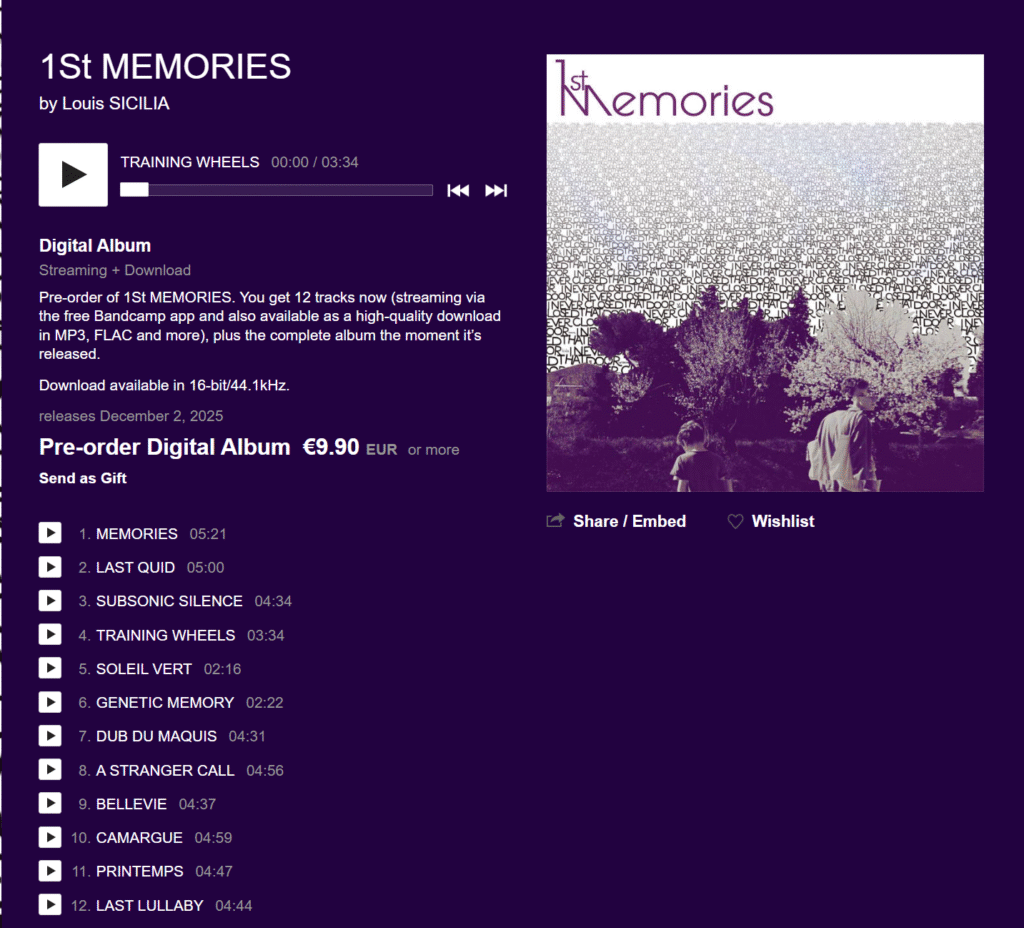
a 12-track album shaped by fragments of youth, late-night emotions, and the imperfect beauty of real life. Born from spontaneous moments like a rough afternoon recording with Nina Colwell, the album blends indie textures with house, dub techno, and trip-hop warmth.
As Louis prepares for his debut release on December 2nd, we sat down to uncover the influences, stories, and people behind this emerging artist.
INTERVIEW QUESTIONS
1. Who is Louis Sicilia behind the project?
I started making music seven years ago, pushed by what I was listening to with my brothers. At first, I mainly wanted to learn how to mix, I took a training course with Jeremy Olive from AutoReverse. Very quickly, I turned toward production.
In 2021, I released my first single, which gave me a first gig in Paris, at Folies Pigalle. At the time, everything was being built with my close friends: we came from Avignon, where the scene is less developed, so we organised our own parties and events. It was a way to exist musically, together.
To grow and continue my master’s studies, I ended up moving to Paris three years ago. That’s where I started producing more seriously.
2. You said the title track was recorded “the afternoon after a long night,” with Nina Colwell on Training Wheels. Can you take us back to that moment? What was special about that recording session?
Nina has answered that question.
I met Louis’s friend Leana at la gare le gore (a club in Paris) in December of 2023 and thought she was just incredibly fun to dance with and so beautiful. I had a great time with her that night but then went home and just didn’t think about it again.
About four months later my friend and I went back to the same club and she told me she recognised a girl in front of us. It was Leana from four months ago, I neither of us had been to this club since.
I went up to her immediately and said hello, and we danced together. She introduced me to the guys she was with, Kalani and Louis. Louis told me he made music and I told him I liked to sing.
We were all enjoying each other’s company so they invited me to their afters or, maybe I invited myself, I’m not sure. That’s where Louis played a track for me and I sang over it. Not very meaningful of complex lyrics but just sounds that I thought would work. That became Louis’s and my first track together, ‘Trail of light’.
Some months later I was back in Paris and met up with Louis one evening to try to make some music. That was the aim: to try to make anything. So we made ‘Training Wheels’ in a couple of hours.
It was very spontaneous and we were just having fun together, it was great. The song is about how great it is to meet new people who are just really good people, especially how innocent the feeling is to love one’s new friends so much. That’s how I came up with the title ‘training wheels’, it’s about innocence and about wanting to stay in a good experience forever.
After a few hours we met up with Leana and Kalani and went to club and danced. The whole day was great , because the song is about the four of us, and about the fun we have had together. It a song about friendship made by friends! Louis and I had so much fun that evening, I hope everyone who listens to the track has fun too 🙂
3. Your sound blends indie, house, dub techno, and even trip-hop. How did this hybrid style develop? Which artists or scenes shaped you the most?
During my adolescence, I was mostly influenced by what my brothers were listening to. They were the ones who put me onto Michael Mayer, Nathan Fake, or more generally these collectives Bromance Records, Marble. Without pretending anything, I’ve always had a fairly eclectic taste, and you can feel it in the way I produce: I compose a lot by instinct, always looking first for an atmosphere or an emotion. I’ve never been very comfortable with a too-academic approach.
In the morning, I often listen to Floating Points, Chilly Gonzales or Nils Frahm, soft things that get me moving. Then as the day goes on, I turn to artists like Swayzak, Traumer or El Choop, Groove Armada, more rhythmic, dub and minimal. I don’t have a fixed listening pattern it’s more of an alternation. I often listen to the radio, NTS or FIP.
I had the chance to work on many festivals in Wales, which opened me even more to that British sensitivity for textures, depth, and instinctive emotion in music.
4. What specific memories influenced the atmosphere of the record?
For this first project, I wanted to go back to where everything started, without necessarily realising it. The tracks naturally took on the colours of the landscapes and sensations of the South where I grew up. Nicolas Mathieu describes this atmosphere very well in his novel Leurs enfants après eux: an adolescence that’s a bit raw, simple, but intense.
There were the first parties, the first loves, the afternoons at the pool with my brother and his friends, the nights walking alone between the vineyards.
Looking back, one might think the album carries a form of melancholy, but it wasn’t a sad childhood. It was a dense period, sometimes chaotic, but luminous. Camargue, the track with Afton Roamer, expresses well that crushing summer heat when the music becomes a breath overpowering the mistral wind.
These memories slipped into the tracks without me trying to tell them. They came back as they were: a little blurry, a little rough, but deeply alive.
5. You’ve worked with Nina Colwell and Afton Roamer on this album.
How did these collaborations come about, and how did they shape the final result?
Afton Roamer is one of my best friends for almost ten years. We started mixing together at 15, in my bedroom, on an old Numark turntable. Over time, each of us found our own style, even if we share many influences. Afton has a warmer approach, more anchored in certain codes of club culture. He has a fast, almost surgical technique, and that’s probably why we can so easily imagine a track and translate it into a jam. I keep learning from him at every session.
Nina is a meeting I would have never imagined, but it clicked instantly. Beyond music, I really like her sensitivity and her energetic humour. Training Wheels is our second track together. It’s the one that gave me a clear vision for the album. I had prepared samples and loops that matched her energy and her voice. And within two hours, everything aligned: she played a guitar loop, I added the chords, and the lyrics came to her almost instantly. One single sheet was enough for her, I still have it. The track immediately took me back to my childhood, to that transition toward adolescence, with a soft but very present melancholy. She was the one who found the title “Training Wheels.”
6. You said: “Twelve tracks, twelve faces behind them.”
Can you give us a glimpse into what a few of those ‘faces’ represent? Friends, moments, places?
Behind each track, there is a person, a moment, or an influence that accompanied me in one way or another. I think of Youri, Alex, Jamy, Tristan, Arthur, Leana, Kalani, Nina, Jeremy, Cyril, Harvey, Frazer…
Each one brought something very precise to the project: a different vision, an honest opinion, encouragement at the right moment, feedback that pushed me to adjust a detail, or simply a conversation that unlocked an idea.
In short, a contribution that really matters to me.
I never closed that door <3
7. How do you usually build a track?
Are you more intuitive or structured when producing?
I don’t really have a fixed pattern to build a track. Over time, I mainly learned to prepare my sessions, a bit like preparing a DJ set: when everything is in place, improvisation and luck have more room to exist.
In general, I start from a sample or a preset to create a first guiding line, then I build around it. I often start with the melody, because that’s what sets the emotional tone. On this project, most of the tracks were composed in a quite intuitive way: it’s really a logic of the moment.
I tried for a long time to work with a more “hardware” setup: synths, drum machines, samplers… But the cost of the equipment and the space it requires quickly held me back. In the end, I switched most of my workflow to VSTs. I often use the SH-02, paired with the RE-201 for the main pads.
8. Now that Memories is done, where do you see your sound going next?
Is there anything you want to explore sonically or visually in 2026?**
For the future, I want to stay in the continuity of First Memories, without breaking my universe. I’m leaning toward a format shorter than the album, with an approach that resonates more with the club. Without speeding up the tempo or losing what defines my identity. What interests me most is reworking my arrangements so my tracks naturally find their place in a club context while keeping that intimate dimension. I’m open to collaborations, so feel free to reach out.
I’m already working on a new project, more colourful, planned for next year. I’d like to push further the link between my sound textures and the visual aesthetic that goes with them. That’s what I started exploring with the Training Wheels video. For different reasons, I ended up choosing animation, and I really enjoyed the process: writing, imagining scenes, giving a visual form to an emotion or a memory.
It’s a direction I want to open further: making music for images, getting closer to the world of cinema or advertising in parallel.